
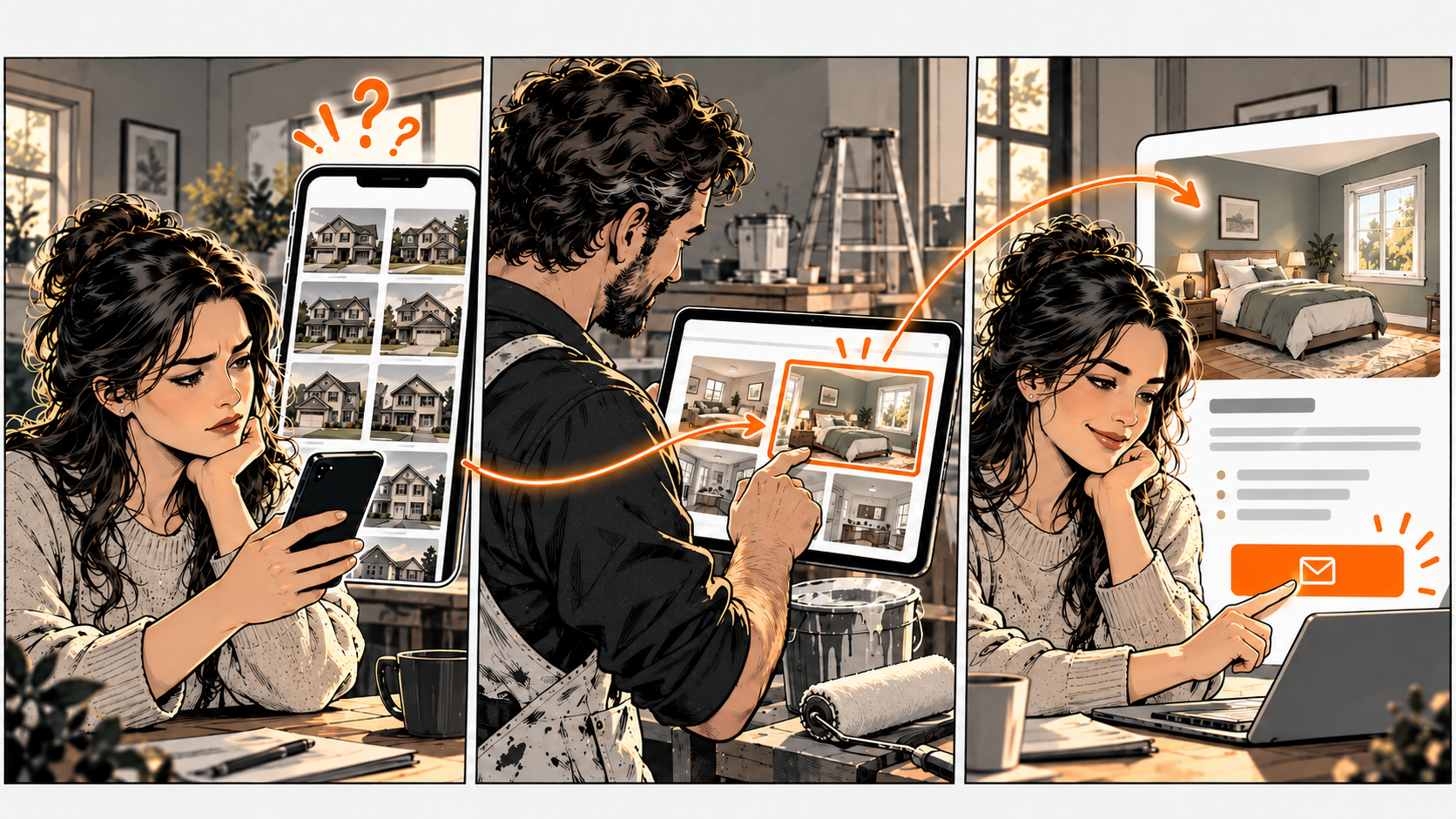
Evidence Placement Map Use the complete check on this page for one situation in your business.
The right proof in the right place
Place relevant evidence near the information it supports. Someone deciding whether a painter handles small interior jobs needs different detail from someone comparing exterior projects. More testimonials don't automatically answer either question.
A painter's homepage has a gallery of large houses. A visitor wants one room painted. A labelled example of a completed room — with the actual scope and permission to show it — explains that service more directly.
Use the right kind of evidence
A project photo shows visible work. A service description explains what was included. A customer review records that person's experience. A licence or qualification has a specific issuer and meaning. Label each accurately — don't treat them as interchangeable.
Don't invent testimonials, imply a stock photo is your work, or present an old project as current. Get permission for identifiable customer work and avoid including private details.
Keep the source within reach
When you refer to an external review, give a clear destination for the reader to examine it. Don't imply a review link displays reviews on your page. Check that it leads to the correct business and location.
Quoting or reusing review content needs attention to permission, platform terms, and accurate attribution. A direct link is often the simplest starting point.
Google describes reviews as information that can help potential customers and values honest, balanced feedback.
Put it where the uncertainty appears
For the painter, show the room example near the interior-painting description and the inquiry action. Keep extensive galleries on a detail page if they'd crowd the card.
Your DiagBizCard can point toward the relevant example or review destination when the available links support that route.
Ask a new reader what the evidence establishes and what it doesn't. If they infer a guarantee you didn't intend, correct the caption or surrounding text.
The Evidence Placement Map
Pick one real situation. Copy these five lines into your notes and fill them in. The complete tool is right here — no signup or email needed.
- Decision — What is the visitor trying to decide?
- Doubt — What remains uncertain?
- Evidence — Which genuine example or source addresses it?
- Context — What scope, date, or limitation matters?
- Placement — Where can they see it before choosing?
Example: whether a painter accepts one-room work / gallery shows only large houses / permissioned finished-room photo / caption describes that project's scope / interior service page beside the inquiry action.
If no evidence supports the claim, narrow the claim. If the evidence is genuine but irrelevant, choose another example. If it helps, keep its source and context visible.
Common questions
How many reviews do I need?
There's no number established by this worksheet. Start with relevant, genuine information a reader can inspect.
Does an example guarantee the same result?
No. Explain what the example shows and any conditions. Don't turn a previous outcome into a promise for every customer.
Sources
Source: Google Business Profile Help, Tips to get more reviews: https://support.google.com/business/answer/3474122?hl=en
Trust has to be visible where the decision happens
A new visitor who has never worked with you has no reason to trust a claim. What they need is evidence they can see at the moment they're deciding — a real example, a specific answer to a doubt they actually have, or a detail that shows you've handled their situation before. Proof buried on a separate page doesn't help; proof placed where the choice is made does. Being found gets them to the page. Being chosen takes evidence they can see right there.